If you’re confused about the difference between 12V LiFePO4 and lead acid batteries, which one offers better value, longer lifespan, and more stable performance, this detailed comparison guide will help you make the best decision for your power system.
1. Core Difference: Cycle Life & Durability
Battery cycle life determines how long your battery can last in daily use, which directly affects long-term replacement costs.
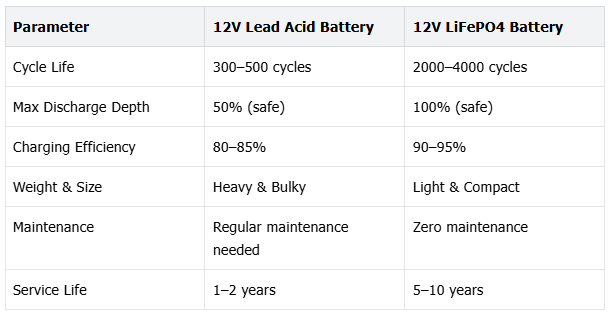
12V Lead Acid Battery: Standard lead acid and AGM batteries only support 300–500 full charge-discharge cycles. Deep discharges will severely damage the internal plates, causing capacity attenuation and short service life. Most lead acid batteries need replacement within 1–2 years for frequent daily use scenarios.
12V LiFePO4 Battery: LiFePO4 batteries feature ultra-long cycle life, supporting 2000–4000 full cycles with minimal capacity loss. Even after thousands of cycles, the battery can maintain over 80% of its original capacity. With proper use, a 12V LiFePO4 battery can work stably for 5–10 years, far exceeding lead acid batteries.
2. Usable Capacity & Discharge Depth
This is one of the biggest hidden differences between 12V LiFePO4 and lead acid batteries. Many users find lead acid batteries “not durable” simply because of their strict discharge limits.
12V Lead Acid Battery: Experts recommend only 50% maximum discharge depth. Discharging below 50% will cause irreversible damage, shorten lifespan, and even cause battery bulging and failure. That means a 100Ah 12V lead acid battery only has 50Ah of actual usable capacity.
12V LiFePO4 Battery: Supports 100% deep discharge safely without damaging the battery. A 100Ah 12V LiFePO4 battery provides full 100Ah usable capacity. Compared with the same-spec lead acid battery, LiFePO4 delivers double the actual power output.
3. Energy Density & Weight
Weight and volume are key factors for mobile scenarios like RVs, yachts, and portable camping power stations.
12V Lead Acid Battery: Low energy density (30–50Wh/kg). It is bulky and extremely heavy, increasing overall load and transportation costs. It is not suitable for mobile or lightweight equipment.
12V LiFePO4 Battery: High energy density (120–160Wh/kg). It is 50% lighter and 30% smaller than equivalent lead acid batteries. It is easy to install, carry, and transport, perfectly fitting mobile power scenarios.
4. Charging Efficiency & Performance Stability
Charging speed and voltage stability directly affect the user experience of solar power and backup power systems.
12V Lead Acid Battery: Low charging efficiency of about 80–85%. It charges slowly and cannot accept high-current fast charging. In addition, its voltage drops sharply during discharge, resulting in dim lights and unstable device operation.
12V LiFePO4 Battery: High charging efficiency up to 95%. It supports fast charging and makes full use of solar power or grid power. Most importantly, LiFePO4 batteries maintain constant stable voltage throughout the discharge process, ensuring consistent power supply for devices.
5. Maintenance & Safety
Low maintenance and high safety are core advantages of modern lithium batteries.
12V Lead Acid Battery: Flooded lead acid batteries require regular maintenance, including electrolyte inspection and water refilling. They are prone to acid leakage, corrosion, and heat generation. In high-temperature or over-discharge environments, bulging and failure often occur.
12V LiFePO4 Battery: Zero maintenance design, no need for water refilling or regular inspection. Built-in professional BMS (Battery Management System) provides overcharge, over-discharge, over-current, short circuit, and temperature protection. The chemical structure of LiFePO4 is extremely stable, with no risk of explosion or fire, featuring excellent high and low temperature resistance.
6. Cost Performance (Long-Term Value)
Many users choose lead acid batteries for their low upfront cost, but ignore long-term comprehensive costs.
12V Lead Acid Battery: Cheap initial price, but frequent replacement is required. In 5 years, you need to replace 3–4 sets of lead acid batteries, with high cumulative replacement and maintenance costs.
12V LiFePO4 Battery: Slightly higher one-time investment, but ultra-long service life eliminates frequent replacement troubles. In the long run,
LiFePO4 batteries have 60% lower comprehensive use cost than lead acid batteries.
Quick Comparison Table: 12V LiFePO4 vs Lead Acid Battery
Which One Should You Choose?
Choose 12V Lead Acid Battery if: You have a very limited budget, use the battery occasionally, or need temporary standby power for simple fixed equipment.
Choose 12V LiFePO4 Battery if: You need batteries for solar energy storage, RVs, boats, camping, UPS backup power, off-grid power systems, and long-term continuous use scenarios. It is the most cost-effective and reliable power solution for long-term use.
Final Verdict
12V lead acid batteries still have a place in low-budget, low-frequency usage scenarios. However, in terms of service life, usable capacity, charging efficiency, safety, and long-term cost performance, 12V LiFePO4 batteries completely outperform lead acid batteries. For most residential and commercial off-grid power systems, LiFePO4 is undoubtedly the better upgrade choice in 2026.
Looking for high-quality 12V LiFePO4 batteries with stable performance and long lifespan? We provide customized 12V LiFePO4 batteries of various capacities (50Ah, 100Ah, 200Ah) with complete CE, FCC, UN38.3 certifications. Contact us today to get a free quote and professional power solution!


